Blog

  • Solubility of Acid Gases in TEG Solution: Part 3 (CO2 in TEG)

    The solubility of acid gases in TEG solution has been the subject of two previous Tips of the Month, (June 2012 and July 2012).  In these instances, the focus was on gas streams with maximum acid gas partial pressure of 100 psia (690 kPa) and TEG concentrations of 95 and 100 wt%.   This is typical for dehydration of sour gas streams.

    This month, the focus shifts to the case where the gas is pure CO2, with partial pressures (and system pressures) ranging up to 800 psia (5 500 kPa), and pure TEG.  These conditions approximate the dehydration of high-CO2 content gases in a CO2 enhanced oil recovery project, or perhaps, CO2 from an industrial source that is to be compressed, transported and sequestered.

    Two algorithms have been developed to predict the CO2 solubility in pure TEG.  One algorithm uses the same format as the Mamrosh-Fisher-Matthews [1] Solubility Model presented in the June 2012 and July 2012 Tips of the Month.  In order to improve the correlation for pure CO2 and TEG, the equation parameters (A through D) were regressed using data extracted from Figure 20-76 of the GPSA Engineering Data Book [2].  The equation and new parameters are presented below.

    In the second algorithm, we propose a 6-parameter empirical equation, which is also regressed from the GPSA Figure 20-76 [2].


    Mamrosh-Fisher-Matthews Solubility Model MODIFIED:

    The original Mamrosh et al. [1] model, was first applied to data extracted from GPSA Figure 20-76 [2].  Average Absolute Percentage Deviation (AAPD) was greater than 6.5% and the Maximum Absolute Percentage Difference for the data set exceeded 34%.  To improve accuracy, a multi-parameter regression was performed using data from Figure 20-76.  The new values for Parameters A, B, and D (C was set to zero and the original value of E was used) are presented in Table 1 below.

    Where:

    P is the absolute pressure, psia (kPa(a))

    T is the absolute temperature, °R (K)

    xi is the mole fraction of the acid gas in the liquid phase

    yi is the mole fraction of acid gas in the vapor phase


    Note that the mole fraction of water in the liquid (  is zero (pure TEG), so parameter “C” has been set to zero.

    Table 1. MODIFIED Parameters for Mamrosh et al. model [1]

    System: Pure CO2 in100%TEG

    A

    B

    C

    D

    E

    (FPS)

    7.4188

    -2727.79

    0

    0.11164

    0.001864

    (SI)

    9.3508

    -1515.44

    0

    0.008996

    0.003355

    Accuracy of MODIFIED Mamrosh-Fisher-Matthews Solubility Model:

    The accuracy of the MODIFIED Mamrosh et al. [1] model was evaluated against the data extracted from Figure 20-76 of Gas Processors Suppliers Association Engineering Data Book, 12th Edition [2].  The summary of our evaluation results is shown in Table 2.

    Table 2. Summary of error analysis for MODIFIED Mamrosh et al. model

    System

    N

    AAPD

    MAPD

    T Range, ˚F

    (˚C)

    P Range, psia (kPa)

    Pure CO2 in 100% TEG

    1018

    1.85

    10.08

    77 – 165

    (25 – 75)

    15 – 800

     (100 – 5500)


    Where:

    N = Number of data points

    xi  = mole fraction of acid gas in the liquid phase

    Figure 1 presents the data extracted from GPSA Figure 20-76  [2]  for the solubility of pure CO2 in 100% TEG, and the predicted values from the MODIFIED Mamrosh et al. equation.  GPSA data points are denoted as symbols: Equation results are shown as solid lines.

    Overall the accuracy is very good.  At 15 psia, the error looks significant, and the absolute percentage deviation is as high as 10%. However; the actual solubility is small, so the magnitude of the error in physical terms is insignificant.

    Proposed CO2 Solubility Model:

    A 6-parameter empirical model was developed by regression of the data extracted from GPSA Figure 20-76  [2].  The general form of the equation is presented as Equation (2) and the values for the six parameters are provided in Table 3.  The model is suitable only for pure CO2 and 100% TEG.


    Figure 1 (FPS). Solubility of pure CO2 in 100% TEG – GPSA Fig. 20-76 versus MODIFIED Mamrosh et al. Model

    NOTE:  Data points from GPSA Fig. 20-76 [2] denoted by symbols: Equation is denoted by solid lines


    Figure 1 (SI). Predicted solubility of pure CO2 in 100% TEG – by MODIFIED Mamrosh et al. Model

    Table 2.  Parameters for Moshfeghian model for pure CO2 in 100% TEG

    Units

    X1

    X2

    X3

    X4

    X5

    X6

    A

    (FPS)

    639.076

    150.431

    -2.6482

    0.01178

    0.003564

    2.1731

    1

    (SI)

    355.042

    1037.19

    -2.6482

    0.01178

    0.003564

    2.1731

    7.4625


    Accuracy of the Proposed Solubility Model:

    The accuracy of the proposed model was evaluated against the data extracted from Figure 20-76 of Gas Processors Suppliers Association Engineering Data Book, 12th Edition [2]. The summary of our evaluation results is shown in Table 3.


    Table 3. Summary of error analysis for Moshfeghian model.

    System

    N

    AAPD

    MAPD

    T Range, ˚F

    (˚C)

    P Range, psia (kPa)

    Pure CO2 in 100% TEG

    1018

    1.50

    7.14

    77 – 165

    (25 – 75)

    15 – 800

     (100 – 5500)


    Where AAPD and MAPD are as defined above.

    Figure 2 presents the data extracted from GPSA Figure 20-76  [2] for the solubility of pure CO2 in 100% TEG, and the predicted values from the proposed Model.  GPSA data points are denoted as symbols: Equation results are shown as solid lines.  Also included in Figure 2 are nine data points from GPA Technical Publication TP-9 [3].  These data points are actual values measured for pure CO2 and 100% TEG at three pressures. Note the TP-9 data were not used in the regression process.

    The accuracy of the proposed Model is slightly better than the MODIFIED Mamrosh et al. model.  Average and Maximum Absolute Percentage Deviations are both reduced.  As with the MODIFIED Mamrosh et al. model, the greatest percentage error corresponds to the low pressure case (15 psia or 104 kPa) where the solubility is very small, so the actual deviation is likely insignificant for most engineering calculations.

    Figure 3 presents the selected data from GPA RR 183 [4] for the solubility of pure CO2 in 100% TEG, and the predicted values from the Modified Mamrosh et al. Model and the Proposed Model. These GPA data were not used in regressing either of the two models parameters.

    Figure 2 (FPS)  Solubility of pure CO2 in 100% TEG – GPSA Fig. 20-76 versus the proposed model

    NOTES:     Data points extracted from GPSA Fig. 20-76 [2] denoted by symbols: Equation is denoted by solid lines

    Large Black symbols and solid lines denote data from GPA TP9 [3]

    Figure 2 (SI)  Predicted solubility of pure CO2 in 100% TEG by the proposed Model


    Figure 3.  Comparison of the predicted solubility of pure CO2 in 100% TEG at 72.5 psia (500 kPaa) with the GPA RR 183 experimental data [4]


    Conclusions:

    Two new algorithms have been developed to predict the solubility of pure CO2 in 100% TEG.  Both algorithms were developed by regressing data extracted from Figure 20-76 of the Gas Processors Suppliers Association Engineering Data Books [2]. It should be noted that the Figures in GPSA are attributed to Ed Wichert, Sogapro Engineering with all rights reserved.

    The first algorithm is a Modified form of the Mamrosh et al. model [1].  The original model was presented and evaluated for CO2 concentrations of up to 10 mole percent in the June and July 2012 Tips of the Month. However, model predictions for pure CO2 and 100% TEG produced an average absolute percentage deviation (AAPD) of more than 6.5%, and a Maximum Absolute Percent Deviation (MAPD) of more than 34% compared with data extracted from Figure 20-76 of the GPSA Engineering Data book [2]. To improve accuracy, the equation parameters were regressed with data points extracted from Figure 20-76.  The Modified Mamrosh et al. model more accurately reproduces the curves in Figure 20-76, with an AAPD of 1.85% and MAPD of 10.1%.

    The second algorithm, the proposed Model, uses a different form of the equation.  The six parameter model was also tuned to match data from GPSA Figure 20-76 [2].  The resulting AAPD is 1.50%, and the MAPD is 7.14% compared to Figure 20-76.

    To learn more about similar cases and how to minimize operational problems, we suggest attending our G40 (Process/Facility Fundamentals), G4 (Gas Conditioning and Processing), P81 (CO2 Surface Facilities), and PF4 (Oil Production and Processing Facilities) courses.

    John M. Campbell Consulting (JMCC) offers consulting expertise on this subject and many others. For more information about the services JMCC provides, visit our website at www.jmcampbellconsulting.com, or email us at consulting@jmcampbell.com.

    By: Wes H. Wright  &  Dr. Mahmood Moshfeghian 

    Reference:

    1. Mamrosh, D., Fisher, K. and J. Matthews, “Preparing solubility data for use by the gas processing industry:  Updating Key Resources,” Presented at 91st Gas Processors Association National Convention, New Orleans, Louisiana, USA, April 15-18, 2012.
    2. Gas Processors Suppliers Association; “ENGINEERING DATA BOOK” Twelfth Edition – FPS; Tulsa, Oklahoma, USA, 2004.
    3. Takahashi, S., Kobayashi, R., “The water content and the solubility of C02 in equilibrium with DEG-Water and TEG-Water solutions at feasible absorption conditions,” GPA Technical Publication TP-9, Gas Processors Association, Tulsa, Oklahoma, USA, 1982.
    4. Davis, P.M., et al., “The impact of sulfur species on glycol dehydration – Study of the solubility of certain gases and gas mixtures in glycol solutions at the elevated pressures and temperatures,” GPA Research Report 183 (GPA RR 183), Gas Processors Association, Tulsa, Oklahoma, USA, 2002.


  • Should unplanned maintenance jobs be recorded as near misses?

    OSHA mentions “near-misses” as recordable requirements in several passages as: “An unplanned and unforeseeable event that could have resulted, but did not result, in human injury, damage to property or the environment or other form of loss”And we know that all industrial maintenance organizations have a history of reactive, run-to-failure-then-run-to fix, maintenance management behaviors.  JMC’s emphasis on process and equipment reliability and operations management helps to bring facilities out of the reactive mode, but reactive maintenance jobs are still all too prevalent.  Some, or many of these reactive jobs “could have resulted, but did not result, in human injury, damage to property or the environment or other form of loss”.

    Safety is everyone’s number one goal.  Most corporate safety programs define near-misses, but few connect the dots between recordable incidents and the degree of reactive, unplanned maintenance work.  The famous safety pyramid is quite familiar, but that’s only the tip of the safety iceberg.  Below the ‘water line’ of recordable first aids (lagging indicators) lie near-misses and, at the base of it all, safe behavior.  These are the leading indicators of our safety performance. This Tip of the Month will tie reactive maintenance and safe behavior together.

    Recent data, compiled by Belgian’s BEMAS, clearly links accidents with injuries to the percent of reactive maintenance work (the opposite of planned and scheduled work).  If, indeed, a company uses the near-miss definition, how can it not require the recording of some, if not all, unplanned maintenance jobs?

    An iceberg is a good metaphor for Safety; most of its mass lies beneath the surface and we see only the tip.  The safety pyramid compares the quantity of accidents in layers with fatality on the top and reportable incidents on the bottom.  But the real basis of safe behavior lies underneath the reporting surface and is comprised of near misses and unsafe behaviors.

    For over 33 years I have been focused on driving down unplanned maintenance jobs through training and consulting on control of work.  We all should know that planned maintenance is simply safer!  But we have been reluctant to tie urgent, reactive jobs to unsafe practices.  In 2012, it’s time to ask “Should unplanned maintenance jobs be recorded as near-misses”?

    In a nearly parallel development path, our emphasis and understanding of safe work environments has also been refined.  With the help of several catastrophic events, like the Texas


    City refinery and, more recently Deepwater Horizons, and many smaller injury-causing accidents, our industry has put safety on the front burner.

    A useful way to look at the safety pyramid (Figure 1) is to draw the dividing plane at what is reported and not reported.  This brings behavior-based safety programs, which we all talk about, into perspective. A key point here is the separation of leading indicators and lagging indicators.  It’s obvious to record Incidents and Accidents after they happen, but less obvious to capture near-misses and instill safe behaviors.

    Recent data (Figure 2), presented by Wim Vancauwenberghe [1] of the Belgian Maintenance Association (BEMAS) at last year’s SMRP (Society for Maintenance and Reliability Professionals) annual conference shows the impact of unplanned maintenance jobs on the rate of accidents with injuries; and subsequent reduction in injuries as the percentage of planned work increases.

    This raises the question in this paper, and it’s time we asked.

    Clearly, not every unplanned maintenance job involves the same level of risk.  We can use a risk-based approach as in Figure 3 to indicate when an unplanned job becomes a near miss.  When we look at the spectrum of behavior from risk averse upwards to reckless, we can begin to establish some range of criteria for defining what to report. Applying the risk spectrum to the nature of unplanned jobs, we would expect risk to increase due to some factors.  Typical risk matrices compare event likelihood to its consequence to determine level of risk.  Should we develop something similar for unplanned jobs?  This tip attempts to describe the conditions that would determine the level of risk in jobs.  Perhaps there are companies who have successfully addressed this issue and, hopefully they will contribute to this discussion.


    OSHA distinguishes Accident, Incident and Near Miss with the definitions in Figure 4.  However, trying to define what ‘could’ have happened in every urgent job opens a Pandora’s Box that probably wouldn’t be very productive.  On the other hand, we could approach the near miss issue by defining ‘failure’ more carefully.  Taking the familiar P-F curve, we might be able to say that earlier definition of failure at the P point and the subsequent maintenance job would inherently be safer than reacting to a failure at the F point.  Figure 5 shows how that might work.  We could say that anytime we have an unexpected complete failure of equipment, it must be reported as a near miss, whereas, if we detect a potential failure and plan and schedule the maintenance action before complete functional failure, it wouldn’t need to be reported because it is not a near miss.


    If we are going to require near misses to be reported, another issue is raised:  How is a near miss to be reported?  What do we do with the report?  How much information/data is required on such a report?  If we’re going to require a report, we will have to define what and how much detail is required.

    There are several possible uses for a near miss report.  Whatever decision we take, will impact our staff with more information gathering tasks.  What is it worth?  How can we successfully use the report to lower near misses and effect safer behavior?  Or, drive down reactive maintenance work?

    • Used as a way to ‘speak up’ with the rest of the crew and raise their awareness would not require as much information about what happened,
    • Determine preventability of the near miss with root cause analysis would require a great deal more information.

    The fundamental questions are:

    • How do we raise the awareness of near misses with the target to reduce them?
    • What distinguishes a near miss from an incident?
    • If unplanned maintenance jobs carry higher safety risk, how do we break our reactive maintenance habits?
    • What criteria do we use to define levels of risk?

    In order to determine how the professional SMRP audience would distinguish the reportability of near misses, several situations were presented for the participants to vote using the following choices:

    1. Do it and report as a near miss
    2. Near miss, Speak up!
    3. Risky behavior, don’t tell anyone
    4. No risk, just do it!
    5. Do not proceed without a planned work order

    The sample situations were:

    • Urgent restart of a 100 hp motor after unexpected stoppage
    • Talking on your cell phone while driving
    • Vehicle crossing your path while running a yellow light
    • 5 lb. (2.27 kg) hammer dropped from scaffolding
    • Hurrying to replace hydraulic fitting without lock out, tag out
    • 2 ton lifting sling frayed, but go ahead and use it

    Results of this voting may be published in a subsequent TOTM, or send an email to the author, perry.lovelace@jmcampbell.com.

    In conclusion, we have raised the question and some of the issues around the question “Should unplanned maintenance jobs be recorded as near misses?”  There is not a simple answer and our profession must continue to explore the issues and make efforts to create a safer workplace through planned and scheduled maintenance work.

    To this end, JMC offers training related to reducing unexpected failures:

    • The Operations Management discipline is directly focused on reduction of unplanned events through better control of work,
    • Operator Training broadens facilities operators’ competencies by teaching how facilities work and why certain events happen,
    • Mechanical and Reliability disciplines help identify onset of equipment failures.  Reliable equipment is safer equipment,
    • Many facilities use contractors for maintenance; their safety is also important.  JMC’s Supply Chain and Procurement disciplines concentrate on better contractor relationships in our SC-41 course.

    To learn more about similar cases and how to minimize operational problems, we suggest attending our G40 (Process/Facility Fundamentals), G4 (Gas Conditioning and Processing), G5 (Gas Conditioning and Processing-Special), P81 (CO2 Surface Facilities), PF4 (Oil Production and Processing Facilities), and PL 4 (Fundamentals of Onshore and Offshore Pipeline Systems) courses.


    John M. Campbell Consulting (JMCC) offers consulting expertise on this subject and many others. For more information about the services JMCC provides, visit our website at www.jmcampbellconsulting.com, or email your consulting needs to consulting@jmcampbell.com.


    By: Perry Lovelace, Sr. Staff Instructor

    References:

    1. Vancauwenberghe, Wim; The Basics of Safe Maintenance; The Belgian Maintenance Association; 2011.
  • Low Pressure Versus High Pressure Dense Phase Natural Gas Pipeline Transportation

    Dense phase is a favorable condition for transporting carbon dioxide (CO2) and natural gas as well as carbon dioxide injection into crude oil reservoir for enhanced oil recovery. Pipelines have been built to transport CO2 and natural gas [1] in the dense phase region due to its higher density, and this also provides the added benefit of no liquids formation in the pipeline.

    Recently (January through April 2012 TOTMs) we discussed several aspects of transportation of carbon dioxide (CO2) in the dense phase. We illustrated how thermophysical properties change in the dense phase and their impacts on pressure drop calculations. The pressure drop calculation utilizing the liquid phase and vapor phase equations were compared. In the August 2012 Tip of The Month (TOTM) [2], we studied transportation of rich natural gas in the dense phase region and compared the results with the case of transporting the same gas using a two phase (gas-liquid) option. Our study highlighted the pros and cons of dense phase transportation.

    In this TOTM, we will study the low pressure versus high pressure (dense phase) pipeline transportation of a lean natural gas. The application of dense phase in the oil and gas industry will be discussed briefly.

    Case Study:

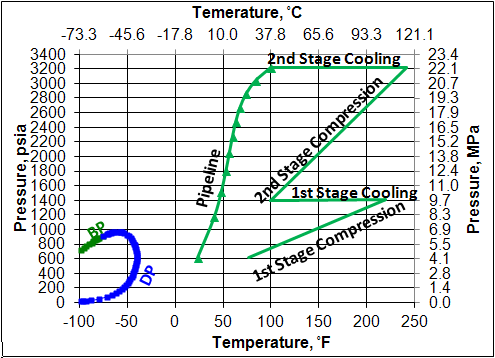
    For the purpose of illustration, we will consider transporting a natural gas mixture with composition and conditions presented in Table 1. For simplicity, the calculations and subsequent discussion will be done on the dry basis. The feed gas dew point was reduced to -40 ˚F (-40 ˚C) by passing it through a mechanical refrigeration dew point control plant. Figure 1 presents the phase envelopes for the feed and lean (pipeline) gases. The composition and conditions of the lean gas are also presented in Table 1. The 1000 miles (1609 km) long pipeline with a  diameters of 42 inches (1067 mm) has been considered. A simplistic Process Flow Diagram (PFD) is shown in Figure 2. The following assumptions and correlations are/used:

    1. Dry basis, ignoring water.
    2. C7+ considered as nC8.
    3. Steady state
    4. Delivery pressure is 615 Psia (4.24 MPa).
    5. Pressure drop in each heat exchanger is 5 psi (0.035 MPa).
    6. No pressure drop in scrubbers and separators.
    7. Horizontal pipeline, no elevation change.
    8. Inside surface absolute roughness is 0.0018 in (0.046 mm).
    9. Single Phase Friction Factor: Colebrook
    10. For calculation purpose, each line segment was divided into 10 sub segments.
    11. Overall Heat Transfer Coefficient: 0.25 Btu/hr-ft2-˚F (1.42 W/m2-˚C).
    12. Simulation software: ProMax [3]
    13. Equation of State: Soave-Redlich-Kwong (SRK).

    Table 1. Composition and conditions of the feed gas and lean gas


    Figure 1. Phase envelopes for the feed (rich) and pipeline (lean) gas


    Three cases for transportation of this natural gas are considered and each is explained briefly in the proceeding section. Figure 2 presents the PFDs for Cases A and B. Case C PFD is similar to Case B with 2 more pipeline segments, compressors and coolers. Figure 3 illustrates the pipeline systems in a block diagram.  The number of pipeline segments, segment length, and inlet pressure of each segment for the three cases are presented in Table 2 in the field (FPS, foot, pound and second) and SI (System International) sets of units.

    Figure 2. Process flow diagrams (PFD) for Cases A and B (Case C is similar to Case B)


    Figure 3. Pipeline Block Diagrams for Cases A, B, and C

    Table 2. Pipeline specifications for the three cases


    Case A: High Pressure (Dense Phase)

    After passing through the first stage scrubber, the lean gas enters the first stage of compressor where its pressure is raised to 1407 psia (9.703 MPa), then it is cooled to 100 ˚F (37.8 ˚C) and compressed further in the second stage to 3220 Psia (22.2 MPa). The high pressure compressed gas is cooled back to 100 ˚F (37.8 ˚C) and then passed through a separator before entering the long pipeline (See Case A in Figure 2).


    Case B: Intermediate Pressure

    The process flow diagram (PFD) for this case is also shown in Figure 2. In this case, the pipeline is divided into three 333.3-mile (536.2 km) pipelines with one lead compressor station and two intermediate compressor stations. In each station, the pressure is raised from 615 Psia to 1966 Psia (4.24 to 13.56 MPa) in one stage and then cooled to 100 ˚F (37.8 ˚C), passed through a separator before entering the downstream pipeline segment.


    Case C: Low Pressure

    This case is similar to Case B except the pipeline is divided into five 200-mile (322 km) pipeline segments with one lead compressor station and 4 intermediate compressor stations. In each station, the pressure is raised from 615 Psia to 1600 Psia (4.24 to 11.03 MPa) in one stage and then cooled to 100 ˚F (37.8 ˚C), passed through a separator before entering the downstream pipeline segment.


    Simulation Results and Discussions:

    The PFDs for the three cases are simulated using ProMax [3]. To improve the accuracy and to take care of variations of physical properties of gas, each pipeline segment length was divided into 10 sub segments. For Case A in which pipeline segment was considerably longer, we tried 50 and 100 sub segments and no change in the outlet pressure and temperature was observed. Table 3 presents a summary of simulation results for the three cases in the field and SI system of units. As can be seen in this table, Case A requires the least total compression power and heat duty requirements. The power reduction for Case A is about 51%  compare to Case B and 63% compare to Case C. These reductions in power and heat duty requirements are considerable.  Similarly, the heat duty reduction for Case A is about 39% compared to Case B and 50 % compare to Case C, respectively.

    Table 3. Summary of computer simulation results for the three cases.

    Figure 4 presents the phase envelope, the required compression and cooling stages and pipeline pressure-temperature profile for Case A. This figure shows that the pipeline outlet condition ends up to the right of the dew point curve with the gas remaining as single phase.

    Figure 4. Phase envelope, compression and cooling stages and pipeline pressure-temperature profile (ID=42 in = 1067 mm)

    Pipeline wall thickness is an important economic factor. The wall thickness, t, for the three cases was calculated by:

    Where,

    P is maximum allowable operating pressure, here set to 1.1 times the inlet pressure,

    OD is outside diameter,

    E is joint efficiency (assumed to be 1),

    f1 is wall thickness tolerance (assumed to be 1.0),

    f2 is design factor, 0.4 to 0.72  and here set  to be 0.72 for remote area),

    σ is the pipe material yield stress (assumed pipe material grade X65 to be 65,000 psi or

    448.2 MPa), and

    CA is the corrosion allowance (assumed to be 0 in or 0 mm, for dry gas).


    Figure 5 presents the calculated wall thickness as a function of the inlet pressure (for the three cases). Notice Case A requires the largest and Case C requires the smallest wall thickness.

    Variation of density, viscosity, velocity, pressure, and temperature along the pipeline are shown in Figures 6 through 10 for Cases A and B.

    Conclusions:

    We have studied transportation of natural gas in the dense phase region (high pressure) and compared the results with the cases of transporting the same gas using intermediate and low pressures. Our study highlights the following features:

    1. If the gas at the source is not at high enough pressure, considerable compression power and cooling duty may be required if the decision is to use the dense phase.
    2. For the dense phase – Case A, (high pressure), higher wall thickness is required.
    3. For the dense phase – Case A, lower compressor power and heat duty are required.
    4. For the dense phase – Case A, the friction pressure drop / mile is lower .
    5. For the dense phase – Case A and the same diameter, on the average the velocity is lower compared to lower pressure gas transportation.

    Other logical results can be stated as well including:

    1. Composition of the gas plays an important role.
    2. Pipeline elevation profile and distance may be  important factors at the higher operating pressures.
    3. A detailed economic analysis in terms of CAPEX and OPEX should be made for a sound comparison.

    In a future Tip of the Month, we will consider the design and order of magnitude costs impacts when constructing each of these three cases, first onshore then offshore.

    To learn more about similar cases and how to minimize operational problems, we suggest attending our G40 (Process/Facility Fundamentals), G4 (Gas Conditioning and Processing), G5 (Gas Conditioning and Processing-Special), P81 (CO2 Surface Facilities), PF4 (Oil Production and Processing Facilities), and PL 4 (Fundamentals of Onshore and Offshore Pipeline Systems) courses.

    John M. Campbell Consulting (JMCC) offers consulting expertise on this subject and many others. For more information about the services JMCC provides, visit our website at www.jmcampbellconsulting.com, or email your consulting needs to consulting@jmcampbell.com.

    By: Mahmood Moshfeghian and David Hairston

    References:

    1. Beaubouef, B., “Nord stream completes the world’s longest subsea pipeline,” Offshore, P30, December 2011.
    2. http://www.jmcampbell.com/tip-of-the-month/
    3. ProMax 3.2, Bryan Research and Engineering, Inc., Bryan, Texas, 2012.


    Figure 5. Variation of wall thickness with pipeline inlet pressure

    Figure 6. Variation of gas density in the pipeline (Cases A and B)

    Figure 7. Variation of gas viscosity in the pipeline (Cases A and B)

    Figure 8. Variation of gas velocity in the pipeline (Cases A and B)

    Figure 9. Variation of pressure in the pipeline (Cases A and B)

    Figure 10. Variation of temperature in the pipeline (Cases A and B)

  • Transportation of Natural Gas in Dense Phase

    When a pure compound, in gaseous or liquid state, is heated and compressed above the critical temperature and pressure, it becomes a dense, highly compressed fluid that demonstrates properties of both liquid and gas. For a pure compound above critical pressure and critical temperature, the system is oftentimes referred to as a “dense fluid” or “super critical fluid” to distinguish it from normal vapor and liquid (see Figure 1 in December 2009 Tip Of The Mont (TOTM) [1] for carbon dioxide and in January 2010 TOTM [2] for a typical natural gas). Dense phase is a fourth (Solid, Liquid, Gas, Dense) phase that cannot be described by the senses. The word “fluid” refers to anything that will flow and applies equally well to gas and liquid. Pure compounds in the dense phase or supercritical fluid state normally have better dissolving ability than do the same substances in the liquid state. The dense phase has a viscosity similar to that of a gas, but a density closer to that of a liquid. Dense phase is a favorable condition for transporting CO2 and natural gas as well as carbon dioxide injection into crude oil reservoir for enhanced oil recovery.

    Pipelines have been built to transport CO2 and natural gas [3] in the dense phase region due to its higher density, and this also provides the added benefit of no liquids formation in the pipeline.

    Recently (January through April 2012 TOTMs) we discussed several aspects of transportation of carbon dioxide (CO2) in the dense phase. We illustrated how thermophysical properties change in the dense phase and their impacts on pressure drop calculations. The pressure drop calculation utilizing the liquid phase and vapor phase equations were compared. In this TOTM, we will discuss the dense phase transportation of natural gas. The application of dense phase in the oil and gas industry will be discussed briefly.


    Case Study:

    For the purpose of illustration, we will consider transporting 244 MMSCFD (6.9×10⁶ Sm3/d) of a natural gas with composition presented in Table 1. The corresponding mass flow rate is 154.95 lbm/sec (70.28 kg/s). For simplicity, the calculations and subsequent discussion will be done on the dry basis. The 100 miles (160.9 km) long pipeline with inside diameters of 14 to 24 inches with an increment of 2 inches  (356 to 610 mm with an increment of 51 mm) have been considered. The inlet conditions are 580 psia (4000 kPa) and 86˚F (30˚C). The following assumptions and correlations are/used:

    1. Dry basis, ignoring water.
    2. C7+ considered as nC8.
    3. Steady state
    4. Delivery pressure is 580 psia (4000 kPa).
    5. Pressure drop in each heat exchanger is 5 psi (35 kPa).
    6. No pressure drop in separators.
    7. Horizontal pipeline, no elevation change.
    8. Inside surface absolute roughness is 0.0018 in (0.046 mm)
    9. Multiphase flow correlation: Beggs and Brill.
    10. Single Phase Friction Factor: Colebrook
    11. Number of Length Increments: 10 (Each segment is 10 mile (16.09 km)
    12. Overall Heat Transfer Coefficient: 0.25 Btu/hr-ft2-˚F (1.42 W/m2-˚C).
    13. Simulation software: ProMax [4]
    14. Equation of State: Soave-Redelich-Kwong (SRK).


    Table 1. Composition of the feed gas

    Two cases for transportation of this natural gas as shown in Figure 1 are considered and each is explained briefly in the proceeding section.Note this is a rich gas stream. A lean gas stream more typical of transmission pipelines would be: 93-97 % CH4, 1-2 % N2/CO2, balance C2+ (mole basis).


    Case 1: Two Phase (Gas and Liquid)

    The gas from the inlet separator (see Figure 1) is compressed to a sufficiently high pressure in two stages to just meet the delivery pressure of 580 psia (4000 kPa) at the destination. The compressed gas after each stage of compression is cooled to 100˚F (37.8˚C). The interstage pressure was set to give equal compression ratio in each stage and approximated the same power requirement for each stage. The outlet separator removes any condensed liquid.


    Case 2: Dense Phase

    The process flow diagram (PFD) for this case is exactly the same as for case 1 with two exceptions:

    1. The pipeline outlet pressure must end up in the dense gas phase region.
    2. A Joule-Thompson (JT) valve is added at the outlet of pipeline to reduce pressure to the specified delivery pressure of 580 psia (4000 kPa) and extract natural gas liquid (NGL).


    Figure 1. Process flow diagrams (PFD) for cases 1 and 2


    Simulation Results and Discussions:

    The two PFDs shown in Figure 1 are simulated using ProMax [4] for the six different inside diameters. Table 2 presents a summary of simulation results for the six inside diameters considered in the field (FPS, foot, pound and second) and SI (System International) sets of units.

    Figure 2 presents the variation of linear pressure drop per length as a function of inside diameter. As expected, the pressure drop decreases as diameter increases. This figure also shows that as diameter decreases, the pressure drop for the Two Phase case increases at a lower rate than the Dense Phase (ratio of pressure drop for small diameter/large diameter ≈ 6.6/1 for Two Phase and ≈ 15/1 for Dense Phase).

    Figure 3 presents the variation of compressor power and cooling duty requirement as a function of inside diameter. Figure 3 indicates that as diameter decreases the energy requirement increases but the difference between the corresponding compressor power and cooling duty for the two cases decreases with smaller size pipelines.

    Since no separation takes place between the inlet and outlet separators, the total composition remains the same as the gas passes through the compressors, coolers, pipeline and JT valve. The flow rate through the equipment between the separators remain constant at 238.73 MMSCFD (6.76×10⁶ Sm3/d). The corresponding mass flow rate is 142.67 lbm/sec (64.71 kg/s).    Figure 4 presents the phase envelope, the required compression and cooling stages and pipeline pressure-temperature profile for the inside diameter of 14 in (356 mm). This figure shows that for the Two Phase case, the pipeline outlet condition after passing through the retrograde region ends up in the two phase region with a liquid fraction of 1.81 %. For Dense Phase case, the pipeline outlet condition ends up above the dew point curve. After passing through the JT valve and reducing the pressure to the specified delivery pressure of 580 psia (4000 kPa), the produced liquid fraction is 3.15 %. In this case the NGL extraction (liquid condensed) is about 74% higher than the Two Phase case. However the Dense Phase case requires more compression power and cooling duties. Table 2 also indicates that:

    • While the fraction of NGL separated (3.15 %) for Dense Phase is independent of the inside diameter, it increases for Two Phase case as diameter deceases.
    • ΔP/unit length decreases with increasing diameter.
    • ΔP/unit length decreases with increasing pressure.
    • Rate of change of ΔP/(unit length-diameter) is lower in the Dense Phase. This is a metric for transportation efficiency – lower is better. Therefore, Dense Phase is the more efficient for transportation.


    Figure 5 shows percent change of different variables of the Dense Phase with respect to the corresponding values in the Two Phase along the pipeline. The % change is defined as: . For the Two Phase case, liquid is formed to the right of the vertical red line at pipeline mile post 70 (113 km). Note that for the Dense Phase the density and viscosity increase compared to the corresponding values in the Two Phase along the pipeline. Toward the end of the line where liquid is formed in the Two Phase case, the increase in density is much higher than that of viscosity. As can be seen in Figure 5, for the Dense Phase, the pressure drop and velocity decrease in comparison to the Two Phase case. These are the factors that make Dense Phase transportation desirable.


    Figure 2. Effect of inside diameter on linear pressure drop

    Table 2. Summary of computer simulation results for six inside diameters.

     Figure 3. Effect of inside diameter on compressor power and cooling duty requirements

    Figure 4. Phase envelope, compression and cooling stages and pipeline pressure-temperature profile (ID=14 in = 356 mm)


    Figure 5. Percent change of different variable in the Dense Phase compared to the corresponding values in the Two Phase along the pipeline (ID=14 in = 356 mm)

                Figure 6 shows where liquid condensation in the pipeline is formed. Figure 6 also indicates that for the Two Phase case, the fluid passes through the retrograde region forming the maximum amount of liquid while no liquid is formed for the case of Dense Phase transportation.

    Pipeline wall thickness is an important economic factor. The wall thickness, t, for 6 diameters studies was calculated by:

    Where, P is maximum allowable working pressure (assumed to be 1.1 times the inlet pressure), OD is outside diameter, E is joint efficiency (assumed to be 1), f1 is wall thickness tolerance, 0.875 to 1.0 (assumed to be 1), f2 is design factor, 0.4 to 0.72 (assumed to be 0.72 for remote area), σ is the pipe material yield stress (assumed pipe material grade X65 to be 65,000 psi or 448.2 MPa), and CA is the corrosion allowance (assumed to be 0 in or 0 mm, for dry gas). Figure 7 presents the calculated wall thickness for the 6 diameters. Notice for the Dense Phase as the diameter decreases, the wall thickness also decreases even though the pressure increases. This is a favorable impact. Opposite behavior is observed for the Two Phase case in which wall thickness increases as diameter decreases (and pressure increases).

    Variation of density, viscosity, velocity, pressure, and temperature along the pipe line are shown in Figures 8 through 12.


    Figure 6. Variation of liquid holdup in the pipeline (ID=14 in = 356 mm)

     Conclusions:


    We have studied transportation of natural gas in the dense phase region and compared the results with the case of transporting the same gas using a two phase (gas-liquid) option. Our study highlights the following features:

    1. If the gas at the source is not at high enough pressure, considerable compression power and cooling duty may be required if the decision is to use the dense phase.
    2. For the dense phase, higher wall thickness is required.
    3. For the dense phase, smaller inside diameter is required.
    4. For the dense phase, the friction pressure drop is smaller.
    5. For the dense phase and the same diameter, the velocity is lower compared to two phase.
    6. For the dense phase, there is a higher potential of NGL extraction due to JT valve expansion.
    7. Since there is no liquid condensation in dense phase, less or no pigging is required.

    Other logical results can be stated as well including:

    1. Composition of the gas plays an important role.
    2. Pipeline elevation profile and distance are important factors.
    3. A detailed economic analysis in terms of CAPEX and OPEX should be made for a sound comparison.

    To learn more about similar cases and how to minimize operational problems, we suggest attending our G40 (Process/Facility Fundamentals), G4 (Gas Conditioning and Processing), G5 (Gas Conditioning and Processing-Special), PF81 (CO2 Surface Facilities), and PF4 (Oil Production and Processing Facilities) courses.

    John M. Campbell Consulting (JMCC) offers consulting expertise on this subject and many others. For more information about the services JMCC provides, visit our website at www.jmcampbellconsulting.com, or email your consulting needs to consulting@jmcampbell.com.

    By: Dr. Mahmood Moshfeghian

    References:

    1. http://www.jmcampbell.com/tip-of-the-month/2010/01/variation-of-properties-in-the- dense-phase-region-part-2-%E2%80%93-natural-gas/
    2. http://www.jmcampbell.com/tip-of-the-month/2010/01/variation-of-properties-in-the- dense-phase-region-part-2-%E2%80%93-natural-gas/
    3. Beaubouef, B., “Nord stream completes the world’s longest subsea pipeline,” Offshore, P30, December 2011.
    4. ProMax 3.2, Bryan Research and Engineering, Inc., Bryan, Texas, 2011.


    Figure 7. Variation of wall thickness with diameter

    Figure 8. Variation of gas density in the pipeline (ID=14 in = 356 mm)

    Figure 9. Variation of gas viscosity in the pipeline (ID=14 in = 356 mm)

    Figure 10. Variation of gas velocity in the pipeline (ID=14 in = 356 mm)

    Figure 11. Variation of pressure in the pipeline (ID=14 in = 356 mm)

    Figure 12. Variation of temperature in the pipeline (ID=14 in = 356 mm)

  • Solubility of Acid Gases in TEG Solution: Part 2

    In the June 2012 Tip of the Month (TOTM), we evaluated the accuracy of a recently published model by Mamrosh et al. [1] against experimental data for CO2 and H2S solubility in triethylene glycol (TEG) solution. Based on this model, we reproduced several diagrams that can be used quickly to determine the absorption of these acid gases in TEG solution. In this TOTM, we have used the same solubility model and produced more diagrams in a different format covering a wide range of operating conditions. The advantage of presenting diagrams in this new format is that less number of diagrams is needed. These diagrams are presented in terms of constant acid gas partial pressure for varying pressure and temperature and constant TEG concentration of 100 and 95 weight percent. A sample calculation showing the application of these diagrams is also provided and the result is compared with ProMax.

    Predicted absorption levels for acid gases can be as high as about 10 SCF/gallon (75 SCM/m3) of TEG solution and depends on temperature, pressure, acid gas concentration in the vapor phase and TEG concentration. As shown in the June 2012 TOTM, the absorption of acid gases increases with TEG purity. The solution of acid gases in TEG solution lowers its pH and enhances corrosion. In addition, one of the main issues is dealing with the H2S that comes off the TEG flash separator and the still regenerator. This is a problem if vented (bad smell & toxic) and can be a significant source of emissions (SO2) if burned.

    Mamrosh-Fisher-Matthews Solubility Model:

    Recently, Mamrosh et al. [1] presented the following correlation based on the experimental data to estimate solubility of CO2 and H2S in TEG solution.

    Wt%TEG is the weight % of TEG in liquid

    The values of the A, B, C, D, and E parameters for international (SI) and engineering field (FPS) units are given in Table 1. For details of the calculation procedure and a sample calculation refer to reference [1].

    Table 1. Parameters for Mamrosh et al. model [2]


    Case Study:
    In Figures 1 through 4 we have reproduced the CO2 and H2S solubility (on volumetric basis of SCF/gallon of TEG solution or SCM/m3 of TEG solution) for TEG concentration of 100 and 95 weight % for pressures of 1000 and 500 (6897 and 3448 kPa) representing contactor pressure, and 75 psia (517 kPa) representing the flash separator in a typical TEG dehydration unit. In each of these diagrams the solubility is presented as a function of temperature, acid gas partial pressure (mole %) in the gas phase based on the model proposed by Mamrosh et al. [1]. These figures are reproduced in the field or Engineering (FPS) and SI (International) systems of units. They can be quickly used to estimate acid gas absorption by TEG solution. In addition, a sample application of these diagrams is presented in the following section.

    The volumetric feed flow rate to a TEG dehydration plant containing 1 mole % H2S is 200 MMSCFD (5.6634×10⁶ SCMD). How many SCFD (SCMD) of H2S are released from the flash separator and regeneration column? The rich TEG concentration is 95 weight % and TEG circulation rate is 27 gallon/min (6.13 m3/h). Assume the contactor operates 100 ˚F (37.8 ˚C) and 1000 psia (6895 kPa). The flash drum operates at 75 psia (517 kPa) and 113 ˚F (45 ˚C) and there is about 6.7 mole % H2S in the flashed gas.

    FPS Solution:

    H2S partial pressure in feed gas = (0.01)(1000 psia) = 10 psia

    From Figure 4 at T=100 ˚F, P = 1000 psia, H2S Partial Pressure= 10 psia,

    0.36 SCF H2S/gallon of TEG is absorbed.

    H2S partial pressure in flashed gas = (0.067)(75 psia) = 5 psia

    From Figure 4 (FPS) at T=113 ˚F, P=75 psia, H2S Partial Pressure= 5 psia,

    0.25 SCF H2S/gallon of TEG is absorbed.

    H2S released with flashed gas = (27 gallon/min)(0.36-0.25)(SCF H2S/gallon TEG) =  2.97 SCF H2S/min = 4.28 MSCFD

    H2S released in regenerator = (27 gallon/min)(0.25)(SCF H2S/gallon TEG) =  6.75 SCF H2S/min = 9.72 MSCFD

    Total H2S released = 4.28 + 9.72 =13.997 MSCFD ≈ 14 MSCFD

    H2S in Feed gas = (0.01)(200 000 MSCFD)=2000 MSCFD

    Fraction of H2S absorbed = 100(14)/2000= 0.7 %

    SI Solution:

    H2S partial pressure in feed gas = (0.01)(6895 kPa) = 69 kPa

    From Figure 4 (SI) at T=37.8 ˚C, P=6895 kPa, H2S Partial Pressure= 69 kPa,

    2.7 SCM H2S/m3 of TEG is absorbed.

    H2S partial pressure in flashed gas = (0.067)(517 kPa) = 35 kPa

    From Figure 4 at T=45 ˚C, P=517 kPa, H2S Partial Pressure= 35 kPa,

    1.9 SCM H2S/m3 of TEG is absorbed.

    H2S released with flashed gas = (6.13 m3/h)(2.7-1.9)( SCM H2S/m3 TEG) = 4.904 SCM H2S/h = 117.7 SCM/d

    H2S released in regenerator = (6.13 m3/h)(1.9)( SCM H2S/m3 TEG) = 11.647 SCM H2S/h = 279.5 SCM/d

    Total H2S released= 117.7 + 279.5 =397.2 SCMD ≈ 400 SCMD

    H2S in Feed gas= (0.01)( 5.6634×10⁶ SCMD)=56 634 SCMD

    Fraction of H2S absorbed = 100(400)/56 634= 0.7 %

    We performed a rigorous simulation of a similar case as the above case study by ProMax [2] and the fraction of H2S absorbed turned out to be 0.78 %.

    Conclusions:

    In continuation of the June 2012 TOTM and to reduce the number of diagrams, we have produced several acid gas solubility diagrams in a different format that can be used quickly to determine the amount of acid gas release in the flash separator and from the regenerator column of a TEG dehydration unit. These diagrams (Figures 1-4) are based on the model developed by Mamrosh et al. [1] and  are in the field (FPS) and SI systems of units and cover a wide range of operating conditions. For a case study, we have presented a sample calculation for estimation of H2S released with the flashed gas off the separator and from the overhead of the regenerator column. The results obtained for this case study compares well with those obtained from rigorous simulation using ProMax [2] software.

    To learn more about similar cases and how to minimize operational problems, we suggest attending our G40 (Process/Facility Fundamentals), G4 (Gas Conditioning and Processing), G5 (Gas Conditioning and Processing-Special), PF81 (CO2 Surface Facilities), and PF4 (Oil Production and Processing Facilities) courses.

    John M. Campbell Consulting (JMCC) offers consulting expertise on this subject and many others. For more information about the services JMCC provides, visit our website at www.jmcampbellconsulting.com, or email your consulting needs to consulting@jmcampbell.com.

    By: Dr. Mahmood Moshfeghian


    Reference:

    1. Mamrosh, D., Fisher, K. and J. Matthews, “Preparing solubility data for use by the gas processing industry:  Updating Key Resources,” Presented at 91st Gas Processors Association National Convention, New Orleans, Louisiana, USA, April 15-18, 2012.
    2. ProMax 3.2, Bryan Research and Engineering, Inc., Bryan, Texas, 2011.

    Figure 1 (FPS). Estimated CO2 solubility in 100 weight % TEG solution as a function of temperature, CO2 mole % (partial pressure) in vapor phase and pressure

    Figure 1 (SI). Estimated CO2 solubility in 100 weight % TEG solution as a function of temperature, CO2 mole % (partial pressure) in vapor phase and pressure

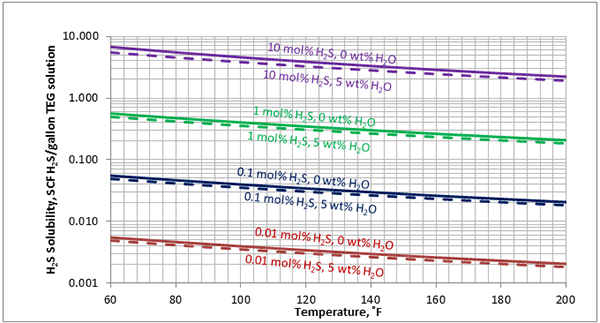
    Figure 2 (FPS). Estimated H2S solubility in 100 weight % TEG solution as a function of temperature, H2S mole % (partial pressure) in vapor phase and pressure

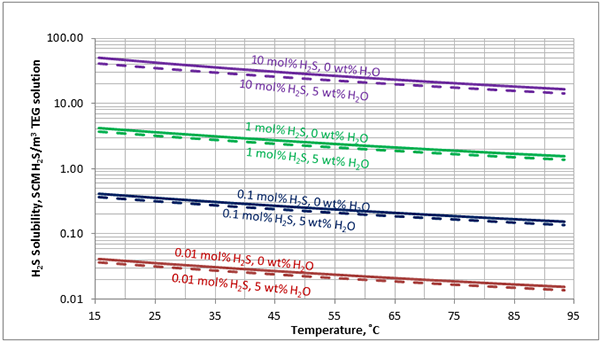
    Figure 2 (SI). Estimated H2S solubility in 100 weight % TEG solution as a function of temperature, H2S mole % (partial pressure) in vapor phase and pressure


    Figure 3 (FPS). Estimated CO2 solubility in 95 weight % TEG solution as a function of temperature, CO2 mole % (partial pressure) in vapor phase and pressure


    Figure 3 (SI). Estimated CO2 solubility in 95 weight % TEG solution as a function of temperature, CO2 mole % (partial pressure) in vapor phase and pressure


    Figure 4 (FPS). Estimated H2S solubility in 95 weight % TEG solution as a function of temperature, H2S mole % (partial pressure) in vapor phase and pressure

    Figure 4 (SI). Estimated H2S solubility in 95 weight % TEG solution as a function of temperature, H2S mole % (partial pressure) in vapor phase and pressure

  • Solubility of Acid Gases in TEG Solution

    In gas dehydration service, triethylene glycol (TEG) will absorb limited quantities of BTEX (benzene, toluene, ethylbenzene, and xylene) and acid gases such as carbon dioxide (CO2) and hydrogen sulfide (H2S) from the gas. Predicted absorption levels for acid gases can be as high as about 10 SCF/gallon (75 SCM/m3) of TEG solution and depends on temperature, pressure, acid gas concentration in the vapor phase and TEG concentration. Figure 18.16 in reference [1] shows the solubility of H2S in TEG at various H2S partial pressures. This is true absorption that takes place in the absorber and corresponds to typical actual plant data. Figure 18.17 also in reference [1] shows solubility of CO2 in a 96.5 weight percent TEG solution. The absorption of acid gases increases with TEG purity. The solution of acid gases in TEG solution lowers its pH and enhances corrosion. In addition, one of the main issues is dealing with the H2S that comes off the still regenerator. This is a problem if vented (bad smell & poisonous) and can be a significant source of emissions (SO2) if burned.

    In the June 2011 tip of the month (TOTM), we presented diagrams for quick estimation of absorption of BTEX in the glycol dehydration systems using the experimental vapor-liquid equilibrium data. The objective of this TOTM is to reproduce similar diagrams covering wide ranges of operating conditions. First we demonstrate the accuracy of a recent model proposed by Mamrosh et al. [2] against Gas Processors Association experimental data and then reproduce some of their recommended diagrams for approximate and quick estimation of acid gas absorption in TEG solution.

    Mamrosh-Fisher-Matthews Solubility Model:

    Recently, Mamrosh et al. [2] presented the following correlation based on the experimental data to estimate solubility of CO2 and H2S in TEG solution.

    The values of the A, B, C, D, and E parameters are given in Table 1. For details of the calculation procedure and a sample calculation refer to reference [2].

    Accuracy of Mamrosh-Fisher-Matthews Solubility Model:

    The accuracy of the Mamrosh et al. [2] model was evaluated against the experimental data of Gas Processor Association Research Reports RR 183 [3] and RR 189 [4] for CO2 and H2S solubility in TEG solution, respectively. The summary of our evaluation results is shown in Table 2.

    It should be noted that for three cases of experimental data of H2S in TEG/H2O system, the absolute percent deviations were abnormally high (128, 260, and 319 %); therefore, they were eliminated from our analysis. Considering the error analysis shown in Table 2, the proposed model by Mamrosh et al. [2] has good accuracy for estimating solubility of acid gases in TEG/H2O solution. All experimental data reported in GPA RR 183 and RR 189 were collected at equilibrium. No consideration in the proposed model is given to the rate at which processes reach equilibrium.

    Figures 1 and 2 present a graphical comparison of the calculated CO2 and H2S solubility (mole fraction of acid gas in the liquid phase) with the experimental data of GPA RR 183 and GPA RR 189 for CO2 and H2S, respectively. Overall, good accuracy is observed for both systems in these two figures. The ranges of data are the same as those shown in Table 2.


    Figure 1. Accuracy of the proposed model by Mamrosh et al. [2] for estimating CO2 solubility in TEG solution against GPA RR 183 experimental data [3]


    Figure 2. Accuracy of the proposed model by Mamrosh et al. [2] for estimating H2S solubility in TEG solution against GPA RR 189 experimental data [4]


    In Figures 3 through and 8 we have reproduced the CO2 and H2S solubility (on volumetric basis of SCF/gallon of TEG solution or SCM/m3 of TEG solution) for pressures of 1000 and 500 (6897 and 3448 kPa) representing contactor pressure, and 50 psia (345 kPa) representing the flash separator in a typical TEG dehydration unit. In each of these diagrams the solubility is presented as a function of temperature, acid gas mole % in the gas phase, and H2O weight % in TEG solution based on the model proposed by Mamrosh et al. [2]. These figures are reproduced in the field or Engineering (FPS) and SI (International) systems of units. They can be quickly used to estimate acid gas absorption by TEG solution. In addition, Figures A1 through A6 in Appendix A present solubility of acid gases in terms mole fraction instead of volume basis.


    Conclusions:

    We have performed an independent evaluation of a recently developed model by Mamrosh et al. [2] for estimation of acid gas absorption by TEG solution while dehydrating natural gas.  Our evaluation was based on the experimentally measured data reported in the GPA RR 183 [3] and GPA RR 189 [4]. All experimental data reported in GPA RR 183 and RR 189 were collected at equilibrium. No consideration in the proposed model is given to the rate at which processes reach equilibrium.

    The analysis of Figures 1 and 2 and Table 2 indicates, that even though the Mamrosh et al. [2] model is simple and easy to use, it is relatively accurate for estimation purposes. It also covers a wide range of operating conditions. Based on this model we have reproduced Figures 3 through 8 in the field and SI systems of units that can be used to estimate the absorption of CO2 and H2S in TEG solution during gas dehydration. The analysis of Figures 3 through 8 also indicates that at the same conditions, the solubility of H2S is almost 5 times greater than that of CO2. In addition, it can be concluded that the absorption of acid gases increase as:

    • Pressure increases
    • Temperature decreases
    • Acid gas concentration in gas phase increases
    • TEG concentration in liquid phase increases
    • TEG solution circulation rate increases

    To learn more about similar cases and how to minimize operational problems, we suggest attending our G40 (Process/Facility Fundamentals), G4 (Gas Conditioning and Processing), PF81 (CO2 Surface Facilities), and PF4 (Oil Production and Processing Facilities) courses.


    John M. Campbell Consulting (JMCC) offers consulting expertise on this subject and many others. For more information about the services JMCC provides, visit our website at www.jmcampbellconsulting.com, or email your consulting needs to consulting@jmcampbell.com.


    By: Dr. Mahmood Moshfeghian


    Figure 3 (FPS). Estimated solubility CO2 in TEG solution at 1000 psia as a function of temperature, CO2 mole % in vapor phase and water weight %


    Figure 3 (SI). Estimated solubility CO2 in TEG solution at 6897 kPa as a function of temperature, CO2 mole % in vapor phase and water weight %


    Figure 4 (FPS). Estimated solubility H2S in TEG solution at 1000 psia as a function of temperature, H2S mole % in vapor phase and water weight %


    Figure 4 (SI). Estimated solubility H2S in TEG solution at 6897 kPa as a function of temperature, H2S mole % in vapor phase and water weight %


    Figure 5 (FPS). Estimated solubility CO2 in TEG solution at 500 psia as a function of temperature, CO2 mole % in vapor phase and water weight %


    Figure 5 (SI). Estimated solubility CO2 in TEG solution at 3448 kPa psia as a function of temperature, CO2 mole % in vapor phase and water weight %


    Figure 6 (FPS). Estimated solubility H2S in TEG solution at 500 psia as a function of temperature, H2S mole % in vapor phase and water weight %


    Figure 6 (SI). Estimated solubility H2S in TEG solution at 3448 kPa as a function of temperature, H2S mole % in vapor phase and water weight %


    Figure 7 (FPS). Estimated solubility CO2 in TEG solution at 50 psia as a function of temperature, CO2 mole % in vapor phase and water weight %


    Figure 7 (SI). Estimated solubility CO2 in TEG solution at 345 kPa psia as a function of temperature, CO2 mole % in vapor phase and water weight %

    Figure 8 (FPS). Estimated solubility H2S in TEG solution at 50 psia as a function of temperature, H2S mole % in vapor phase and water weight %


    Figure 8 (SI). Estimated solubility H2S in TEG solution at 345 kPa as a function of temperature, H2S mole % in vapor phase and water weight %

    Reference:

    1. Campbell, J. M. “Gas conditioning and processing, Volume 2: The Equipment Modules,” John M. Campbell and Company, Norman, Oklahoma, USA, 2001.
    2. Mamrosh, D., Fisher, K. and J. Matthews, “Preparing solubility data for use by the gas processing industry:  Updating Key Resources,” Presented at 91st Gas Processors Association National Convention, New Orleans, Louisiana, USA, April 15-18, 2012.
    3. Davis, P.M., et al.; “The Impact of Sulfur Species on Glycol Dehydration – A Study of the Solubility of Certain Gases and Gas Mixtures in Glycol Solutions at Elevated Pressures and Temperatures, Revised RR Draft for Phase I: CO2/CH4/EG/TEG;” GPA Research Report, RR-183; Gas Processors Association., Tulsa Oklahoma, USA, 2002.
    4. Marriott, R.A., et al.; “The impact of Sulfur Species on Glycol Dehydration – A Study of the Solubility of Certain Gases and Gas Mixtures in Glycol Solutions at Elevated Pressures and Temperatures, VLE Data for the H2S/CH4/EG/H2O System and the H2S/CH4/TEG/H2O System,” GPA Research Report, RR-189; Gas Processors Association., Tulsa Oklahoma, USA, 2005.


    Appendix A

    Additional solubility Diagrams


    Figure A1. Estimated solubility CO2 in TEG solution at 1000 psia [6897 kPa] as a function of temperature, CO2 mole % in vapor phase and water weight %


    Figure A2. Estimated solubility H2S in TEG solution at 1000 psia [6897 kPa] as a function of temperature, H2S mole % in vapor phase and water weight %

    Figure A3. Estimated solubility CO2 in TEG solution at 500 psia [3448 kPa] as a function of temperature, CO2 mole % in vapor phase and water weight %


    Figure A4. Estimated solubility H2S in TEG solution at 500 psia [3448 kPa] as a function of temperature, H2S mole % in vapor phase and water weight %


    Figure A5. Estimated solubility CO2 in TEG solution at 50 psia [345 kPa] as a function of temperature, CO2 mole % in vapor phase and water weight %


    Figure A6. Estimated solubility H2S in TEG solution at 50 psia [345 kPa] as a function of temperature, H2S mole % in vapor phase and water weight %

  • Impact of Non-Hydrocarbons on the Reservoir Fluids Phase Envelope

    Hydrocarbons are frequently produced with non-hydrocarbon impurities. The most common include water, carbon dioxide, hydrogen sulfide and nitrogen. We have already discussed water-hydrocarbon phase behavior in detail in the October and November 2007 Tips of the Month (TOTM). Since water has a low vapor pressure and is virtually immiscible in the hydrocarbon liquid phase, it does not have a significant effect on the shape of the hydrocarbon phase envelope except at high temperatures and low pressures.

    The qualitative effect of CO2, H2S and N2 on the phase envelope of a rich gas or oil is shown in Figure 4.9 on page 100 in reference [1]. As shown in Figure 4.9 a and b, both CO2 and H2S lower the cricondenbar of the mixture. If sufficient quantities of the CO2 and H2S components are added to a reservoir fluid and the reservoir pressure is kept above the phase envelope, a single dense fluid phase exists. Although the actual mechanism is more complex, it is this solubility that is the primary driving force behind miscible flood enhanced oil recovery projects. NGL components such as ethane, propane and butane have a similar effect. With the increasing environmental concerns associated with acid gas (CO2 and/or H2S) injection into the reservoir and enhanced oil recovery, a  good understanding of the impact on phase behavior is essential.

    Nitrogen, on the other hand, raises the cricondenbar and decreases miscibility. It is sometimes used for pressure maintenance. There are also a few nitrogen miscible floods.

    In this TOTM, we will study the impact of CO2, H2S and N2 on the phase behavior of different reservoir fluids such as black oil, volatile oil, and a rich gas. Computer simulated phase envelopes showing the quantitative effect are presented and discussed.

    The Peng-Robinson (PR) [2] equation of state (EOS) option of ProMax [3] was used to perform all of the calculations in this study. In dealing with high content acid gases or nitrogen, care should be taken to verify the accuracy of an equation of state for handling these constituents. In general it is wise to assume the equations of state are inaccurate for modeling the thermodynamic properties and the phase behavior of systems containing high concentrations of non-hydrocarbon components like acid gases and nitrogen. Verification with experimental data is recommended before accepting results from equations of state.

    Case Studies:

    Volatile Oil: Figures 1, 2 and 3 present the impact of CO2 and H2S and their mixture on the phase behavior of a volatile oil. The compositions of the light oil and the acid gas used to generate these two figures are shown in Table 1. For the properties (average normal boiling point, molecular weight and relative density of single carbon number (SCN), see Table 3.3 on page 64 of reference [1].  Both CO2 and H2S lower the cricondenbar of the volatile oil. These quantitative behaviors agree well with the qualitative ones shown in Figure 4.9 a and b. Figure 3 presents the impact of equal molar mixtures of CO2 and H2S on the volatile oil phase envelope. The net effect is almost midway of the effect of CO2 and H2S. In all three figures, the critical point of mixture shifts considerably to the left. The cricondentherm point also shifts to the left as the concentration of acid gases increase. The net effect is enhancing miscibility, shrinkage of the two phase region and expanding the liquid phase region. These are all desirable for enhanced oil recovery.


    Figure 1. The impact of CO2 concentration on the volatile oil phase envelope


    Rich Gas: The compositions of the rich gas and the non-hydrocarbons used to generate Figures 4, 5 and 6 are shown in Table 2. Figures 4, 5 and 6 present the impact of N2, CO2 and H2S on the phase behavior of the rich gas, respectively. As shown in Figure 4, N2 raises the cricondenbar of the rich gas. This quantitative behavior agrees well with the qualitative one shown in Figure 4.9 c. Nitrogen raises the cricondenbar, shifts the critical point to the left and decreases miscibility; therefore, it is best used for pressure maintenance. Miscibility can be attained only at very high pressures. Note for the case of 60 mole % in Figure 3, the bubble point curve and the critical point look abnormal which indicates that the equation of state and/or the binary interaction parameters used are incapable of handling high concentrations of N2

    Figure 2. The impact of H2S concentration on the volatile oil phase envelope


    Figure 3. The impact of acid gas (equal mole H2S and CO2) concentration on the volatile oil phase envelope.

     Figure 5 presents the impact of CO2 concentration on the rich gas phase envelope. Like the case of the volatile oil,  CO2 lowers the cricondenbar,  shifts the cricondentherm to the right but shifts the critical point to the left.

    Figure 6 presents the impact of H2S concentration on the rich gas phase envelope. Both the critical and cricondentherm points shift to the right as H2S increases but the cricondenbar does not lower as it did for CO2.

    Black Oil: Figures 7 and 8 present the impact of CO2 and H2S on the phase behavior of black oil. The compositions of the black oil and the acid gas used to generate these two figures are shown in Table 3.

    As shown in Figure 7, contrary to the case of the volatile oil, the cricondenbar raises as the CO2 content increases but both the critical and cricondentherm points shift to the left. Compared to Figure 1 for the volatile oil, the impact of CO2 on the black oil phase envelope is much less.

                Table 1. Composition of the volatile oil used to generate Figures 1, 2, and 3.

    * Acid Gas = H2S, CO2, or equal molar mixture of H2S, CO2.

    The impact of H2S on this black oil is similar to its impact on the volatile oil (Figure 2). As shown in Figure 8, H2S lowers the cricondenbar of this black oil. The critical point shifts considerably to the left. The cricondentherm point also shifts to the left as the concentration of H2S increases. The net effect is enhancing miscibility, shrinkage of the two-phase region and expanding the liquid phase region. The impact of H2S on the black oil is less compared to the volatile oil shown in Figure 2.


    Figure 4. The impact of N2 concentration on the rich gas phase envelope


    Figure 5. The impact of CO2 concentration on the rich gas phase envelope


    Figure 6. The impact of H2S concentration on the rich gas phase envelope

                Table 2. Composition of the rich gas used to generate Figure 4, 5, and 6.

    * Non-Hydrocarbons = N2, H2S, or CO2,.


    Figure 7. The impact of CO2 concentration on the black oil phase envelope

    Figure 8. The impact of H2S concentration on the black oil phase envelope

                 Table 3. Composition of the black oil used to generate Figures 7 and 8.

    * For properties (average normal boiling point, molecular weight and relative density of single carbon number (SCN), see Table 3.3 page 64 of reference [1].


    Conclusions:

    The analysis of Figures 1 through 8 indicates that the impact of non-hydrocarbons on any reservoir fluids depends on the type/nature and composition of the reservoir fluid. The type of non-hydrocarbon as well as its concentration also plays an important role. The injection of acid gases into a reservoir fluid changes the phase behavior and the thermodynamic properties of the reservoir fluids. Even though not discussed in this TOTM, CO2 injection for the purpose of enhanced oil recovery may cause asphaltene deposition and blockage in the reservoir formation and the surface facilities. Depending on compositions, pressures and temperatures, much more complex phase behavior is possible. Multiple liquid phases (in addition to aqueous phase) and/or solids may be present.

    It is important to use the right tools and an accurate equation of state within simulation software to generate the correct phase envelope. It is recommended to check the accuracy of the thermodynamic models against field/experimental data before generating any phase envelope. The equation of state should be tuned to match the laboratory measured vapor-liquid-equilibria data for a sample of the reservoir fluid before undertaking any practical study/decision. The results shown in this TOTM are specific to the cases studied and have not been validated with actual data. These results should be used only as a guideline.

    To learn more about similar cases and how to minimize operational problems, we suggest attending our G40 (Process/Facility Fundamentals), G4 (Gas Conditioning and Processing), P81 (CO2 Surface Facilities), and PF4 (Oil Production and Processing Facilities) courses.

    John M. Campbell Consulting (JMCC) offers consulting expertise on this subject and many others. For more information about the services JMCC provides, visit our website at www.jmcampbellconsulting.com, or email your consulting needs to consulting@jmcampbell.com.


    By: Dr. Mahmood Moshfeghian

    Reference:

    1. Campbell, J. M. “Gas conditioning and processing, Volume 1: Fundamentals,” John M. Campbell and Company, Norman, Oklahoma, USA, 2001.
    2. Peng, D. Y., and Robinson, D. B., Ind. Eng. Chem. Fundam., Vol. 15, p. 59, 1976.
    3. ProMax 3.2, Bryan Research and Engineering, Inc., Bryan, Texas, 2011.
  • Natural Gas with Dry Ice Phase Behavior

    Wikipedia [1] describes dry ice as “the solid form of carbon dioxide (CO2). It is colorless, odorless, non-flammable, and slightly acidic [2]. At temperatures below −69.9°F (−56.6°C) and pressures below 75.2 psia (518 kPa), the triple point, CO2 changes from a solid to a gas with no intervening liquid form, through a process called sublimation. The opposite process is called deposition, where CO2 changes from the gas to solid  phase (dry ice). At atmospheric pressure, sublimation/ deposition occurs at  −109.3°F (−78.6°C). The density of dry ice varies, but usually ranges between about 87 and 100 lbm/ft3 (1400–1600 kg/m3) [3]. The low temperature and direct sublimation to a gas makes dry ice an effective coolant, since it is colder than water ice and leaves no residue as it changes state [4]. Its enthalpy of sublimation is 245.5 Btu/lbm (571 kJ/kg).”

    While dry ice has many good features and applications, its formation can plug up equipment and cause severe operational problems in gas processing plants. Therefore, accurate predictions of conditions for dry ice formation are required. In order to prevent dry ice formation, a good knowledge and understanding of phase behavior of systems containing carbon dioxide are essential in cryogenic gas processing as in turboexpander plants for deep natural gas liquid (NGL) recovery. Thermodynamic modeling based on the equality of chemical potentials for each component in all phases and application of an equation of state with tuned parameters is normally used for accurate prediction of dry ice formation conditions.

    In this tip of the month (TOTM), we will study the phase behavior of gas mixtures containing carbon dioxide. A description of phase behavior at different conditions of pressure and temperature is presented.

    The Peng-Robinson (PR) [5] equation of state (EOS) option of ProMax [6] was used to perform all of the calculations in this study. In dealing with dry ice, reference [7] discusses the importance of using the right tools in process simulation software. The same reference also demonstrates the accuracy of ProMax against experimental data, including GPA RR 10 experimental data [8], for prediction of dry ice formation at different conditions.

    Case Studies:

    The composition of the two mixtures containing CO2 considered in this study is shown in Table 1. Figure 1 also presents a simplified process flow diagram that was used to study dry ice formation in this study.  The feed gas (stream 1) enters Sep-100 from which the vapor stream (stream 2) is cooled in HEX-100. The stream leaving this cooler is passed through Sep-101 for separation of gas and liquid.

    Figure 2 presents a complete phase envelope for mixture A (see Table 1) in which the state of each region has been identified.

    The feed gas (stream 1) enters Sep-100 at -96˚F and 300 psia (-71.1˚F and 2069 kPa) which is point “A” on Figure 2. At this condition, it is all vapor and all of the feed leaves the separator as vapor. In the HEX-100, the vapor stream (stream 2) is cooled at constant pressure to -160˚F (-106.7˚C), which is represented by point “E” (stream 4). The horizontal dotted straight line identifies the cooling path. During the cooling process when point “B”, the dew point, on Figure 2 is reached, the first drop of liquid is formed. Between points “B and C”, mixture of liquid + vapor coexist at equilibrium. At point C, the incipient point of dry ice, solid phase will also form. Between points “C and D”, three phases of solid + liquid + vapor will coexist at equilibrium. Further cooling to point “E” results in a mixture of solid + liquid at equilibrium. Finally, the stream leaving this cooler is passed through Sep-101 for separation of any gas from and liquid.

    Table 1. The composition of the two mixture studies

    Figure 1. A simplified process diagram for the case study

     If mixture A enters the cooler at a pressure less than 167 psia (1152 kPa) and cools down, it will form dry ice without forming any liquid. As an example, let’s  assume the mixture is at     -100˚F and 100 psia (-73˚C and 690 kPa), point “x” on Figure 2. If this gas is cooled at constant pressure of 100 psia (690 kPa), it forms dry ice at a temperature of about -133˚F (-92˚C). Further cooling below about -137˚F (-94˚C) will form solid + liquid + vapor at equilibrium. Finally, cooling below -200 ˚F (-129˚F) results in a mixture of solid + liquid in equilibrium.


    Figure 2. Complete phase envelope for mixture A.


    At a pressure of 300 psia (2069 kPa), starting at -90°F (-68°C) (Point “A”), the fluid is 100% vapor.  Cooling at constant pressure results in liquid formation when the temperature reaches about -113°F (-81°C) at Point “B”.  Further cooling results in dry ice formation at Point “C” and the temperature is approximately -119°F (-84°).  The last vapor bubble would disappear at Point “D” (about -156°F, -104°C).  Below this point, the fluid exists as dry ice and liquid.

    For the cooling process described above for a constant pressure of 300 psia,  the cooling temperature and vapor fraction of mixture as a function of heat removed from the process fluid (mixture A) in HEX-100 are shown in Figures 3A (Field Units) and 3B (SI Units).


    Figure 3A. Temperature and vapor fraction of mixture A as it passes through HEX-100 (Field Units).


    Figure 3B. Temperature and vapor fraction of mixture A as it passes through HEX-100 (SI Units).

    Each mixture has a unique phase envelope and dry ice formation curve. As the mixture composition changes, the shape of the phase envelope and the dry ice curve will change. Similarly, a complete phase envelope for mixture B with the cooling path is shown in Figures 4, 5A, and 5B.


    Figure 4. Complete phase envelope for mixture B.

    Conclusions:

    In cryogenic processes such as turboexpander plants for deep NGL recovery, accurate prediction of dry ice formation conditions is important. A good knowledge of phase behavior and thorough understanding of dry ice formation can prevent severe operational problems. On the phase envelope, any operating condition that lies on, to the left or below the dry ice curve (the dotted black curves on Figures 2 and 4) will form a solid phase and may cause severe operational problems, damage the equipment and lead to human casualty.

    It is important to use the right tools and an accurate equation of state within simulation software to generate the correct phase envelope and dry ice curve. It is recommended to check the accuracy of the thermodynamic models against experimental data before generating any phase envelope or performing process simulation.


    Figure 5A. Temperature and vapor fraction of mixture B as it passes through HEX-100 (Field Units).


    To learn more about similar cases and how to minimize operational problems, we suggest attending our G40 (Process/Facility Fundamentals), G4 (Gas Conditioning and Processing), PF81 (CO2 Surface Facilities), and PF4 (Oil Production and Processing Facilities) courses.

    John M. Campbell Consulting (JMCC) offers consulting expertise on this subject and many others. For more information about the services JMCC provides, visit our website at www.jmcampbellconsulting.com, or email your consulting needs to consulting@jmcampbell.com.


    By: Dr. Mahmood Moshfeghian


    Figure 5B. Temperature and vapor fraction of mixture B as it passes through HEX-100 (SI Units).


    Reference:

    1. http://en.wikipedia.org/wiki/Dry_ice
    2. Yaws, C. Matheson gas data book (7th ed.). McGraw-Hill Professional. p. 982, 2001
    3. Häring, H-W. Industrial Gases Processing. Christine Ahner. Wiley-VCH, 2008
    4. Treloar, R., Plumbing Encyclopedia (3rd ed.). Wiley-Blackwell, 2003.
    5. Peng, D. Y., and Robinson, D. B., Ind. Eng. Chem. Fundam., Vol. 15, p. 59, 1976.
    6. ProMax 3.2, Bryan Research and Engineering, Inc, Bryan, Texas, 2011.
    7. Hlavinka, M. W., Hernandez, V. N., and McCartney, D., “Proper Interpretation of  Freezing and  Hydrate  Prediction Results From Process Simulation,” Proceedings of the Eighty-Fifth GPA Annual Convention. Grapevine, TX: Gas  Processors Association, 1999:121-127 GPA 2006.
    8. Kurata, F., “Solubility of Solid Carbon Dioxide in Pure Light Hydrocarbons and Mixtures of Light Hydrocarbons,” GPA Research Report RR-10, Gas Processors Association, 1974
  • Effect of Nitrogen Impurities on CO2 Dense Phase Transportation

    In the January and February 2012 tips of the month (TOTM) we discussed the isothermal and non-isothermal transportation of pure carbon dioxide (CO2) in the dense phase region. We illustrated how thermophysical properties changed in the dense phase and studied their impacts on pressure drop calculations. The pressure drop calculation results utilizing the liquid phase and vapor phase equations were exactly the same. We showed that the effect of the overall heat transfer coefficient on the pipeline temperature is significant. In this TOTM, we will study the same case study in the presence of nitrogen impurities under non-isothermal conditions. The Joule-Thompson expansion effect and the heat transfer between pipeline and surroundings have been considered. Specifically, we will report the effect of nitrogen impurities on the pressure and temperature profiles. The Peng-Robinson equation of state (PR EOS) was utilized in this study.

    For a pure compound above critical pressure and critical temperature, the system is often referred to as a “dense fluid” or “super critical fluid” to distinguish it from normal vapor and liquid (see Figure 1 for carbon dioxide in December 2009 TOTM [1]).


    Calculation Procedure:

    The same step-by-step calculation procedure described in the February 2012 TOTM [2] was used to determine the pressure and temperature profiles in a pipeline considering the Joule-Thompson expansion effect and heat transfer between the pipeline and surroundings.

    In the following section we will illustrate the pressure drop calculations for transporting CO2 in dense phase using the gas phase pressure drop equations. For details of pressure drop equations in the gas and liquid phases refer to the January 2012 TOTM [3].


    Case Study:

    For the purpose of illustration, we considered a case study [also described in reference 2] for transporting 160 MMSCFD (4.519×10⁶ Sm3/d) CO2 using a 100 miles (160.9 km) long pipeline with an inside diameter of 15.551 in (395 mm). The inlet conditions were 2030 psia (14 MPa) and 104˚F (40˚C). The following assumptions were made:

    1. CO2, with nitrogen impurities of 0, 1, 5, 10, and 15 mole %.
    2. Horizontal pipeline, no elevation change.
    3. Inside surface relative roughness’s (roughness factor), ε/D, of 0.00013.
    4. The ambient/surrounding temperature,Ts, is 55 ˚F and (12.8 ˚C)
    5. Overall heat transfer coefficients of 0.5 Btu/hr-ft2-˚F (2839 W/m2-˚C).


    Properties: The dense phase behavior and properties were calculated using the Peng-Robinson equation of state (PR EOS) [4] in ProMax [5] software. ProMax was also used to determine pressure and temperature profiles along the pipeline.


    Results and Discussions:

    Figures 1 through 4 present the phase envelope, dry ice (CO2 freeze out) curve, and pipeline pressure and temperature profile for 1, 5, 10, and 15 mole % N2 impurities, respectively, the relative roughness (ε/D) of 0.00013, and the overall heat transfer coefficient (U) of 0.5 Btu/hr-˚F-ft2 (2.839 W/m2-˚C).

    Figure 1. Phase envelop and dense phase pipeline pressure-temperature profile for 99 mole % CO2 + 1 mole % N2, ε/D=0.00013, and U=0.5 Btu/hr-˚F-ft2 (2.839 W/m2-˚C).

    Figure 2. Phase envelop and dense phase pipeline pressure-temperature profile for 95 mole % CO2 + 5 mole % N2, ε/D=0.00013, and U=0.5 Btu/hr-˚F-ft2 (2.839 W/m2-˚C).

    Figure 3. Phase envelop and dense phase pipeline pressure-temperature profile for 90 mole % CO2 + 10 mole % N2, ε/D=0.00013, and U=0.5 Btu/hr-˚F-ft2 (2.839 W/m2-˚C).

    Figure 4. Phase envelop and dense phase pipeline pressure-temperature profile for 85 mole % CO2 + 15 mole % N2, ε/D=0.00013, and U=0.5 Btu/hr-˚F-ft2 (2.839 W/m2-˚C).


    The effect of N2 impurities on the line temperature profile is shown in Figure 5. This figure indicates that N2 impurities have negligible effect on the pipeline temperature profile.

    Figure 6 presents the effect of N2 impurities on the pipeline pressure profile. This figure indicates that as the N2 impurities increases the pressure drop increases. This can be explained by the fact as the N2 impurities increase, the mixture density decreases, consequently the velocity increases. Note the pressure drop is proportional to square of velocity and inverse of density. While viscosity decreases with increase in N2 impurities, its effect is not as large as the density effect. Table 1 presents variation of the mixture density and viscosity as a function of N2 mole %.

    Table 1. Effect of N2 impurities on density (ρ) and viscosity (µ) of mixture at the inlet condition of 2030 psia (14 MPa) and 104˚F (40˚C)


    Conclusions:
     

    Analyzing Table 1 and Figures 1 through 6, the following conclusions can be made:

    1. For the range 0 to 15 mole % N2, the effect of the N2 impurities on the pipeline temperature profile is negligible.
    2. As the N2 impurities increase, the pipeline pressure drop increases due to the change in thermophysical properties of mixture.
    3. Care should be taken to use accurate thermophysical properties and the phase envelope should be plotted to avoid any operating problem.

    Figure 5. Variation of the pipeline temperature profile with the N2 impurities and U=0.5 Btu/hr-˚F-ft2 (2.839 W/m2-˚C)

    Figure 6. Variation of the pipeline pressure profile with the N2 impurities and U=0.5 Btu/hr-˚F-ft2 (2.839 W/m2-˚C)


    To learn more about similar cases and how to minimize operational problems, we suggest attending our G40 (Process/Facility Fundamentals), G4 (Gas Conditioning and Processing), P81 (CO2 Surface Facilities), and PF4 (Oil Production and Processing Facilities) courses.

    John M. Campbell Consulting (JMCC) offers consulting expertise on this subject and many others. For more information about the services JMCC provides, visit our website at www.jmcampbellconsulting.com, or email your consulting needs to consulting@jmcampbell.com.


    By: Dr. Mahmood Moshfeghian

    Reference:

    1. Bothamley, M.E. and Moshfeghian, M., “Variation of properties in the dese phase region; Part 1 – Pure compounds,” TOTM, http://www.jmcampbell.com/tip-of-the-month/2009/12/variation-of-properties-in-the-dense-phase-region-part-1-pure-compounds/, Dec 2009.
    2. Moshfeghian, M., ”Transportation of CO2 in the Dense Phase,” TOTM, http://www.jmcampbell.com/tip-of-the-month/2012/02/ , Feb 2012
    3. Moshfeghian, M., ”Transportation of CO2 in the Dense Phase,” TOTM, http://www.jmcampbell.com/tip-of-the-month/2012/01/, Jan 2012
    4. Peng, D. Y., and Robinson, D. B., Ind. Eng. Chem. Fundam., Vol. 15, p. 59, 1976.

    ProMax 3.2, Bryan Research and Engineering

  • Non-Isothermal Transportation of CO2 in the Dense Phase

     In the January 2012 tip of the month (TOTM) we discussed the isothermal transportation of carbon dioxide (CO2) in the dense phase. We illustrated how thermophysical properties changed in the dense phase and studied their impacts on pressure drop calculations. The pressure drop calculation results utilizing the liquid phase and vapor phase equations were exactly the same. In this TOTM, we will study the same case study under non-isothermal conditions. The Joule-Thompson expansion effect and the heat transfer between pipeline and surroundings have been considered. Specifically, we will report the effects of the overall heat transfer coefficient and the relative roughness on the pressure and temperature profiles. The Span and Wagner CO2 equation of state (EOS) was utilized in this study.

    For a pure compound, above critical pressure and critical temperature, the system is oftentimes referred to as a “dense fluid” or “super critical fluid” to distinguish it from normal vapor and liquid (see Figure 1 for carbon dioxide in December 2009 TOTM [1]).

    Calculation Procedure:

    The following step-by-step calculation procedure may be used to determine the pressure and temperature profiles in a pipeline considering the Joule-Thompson expansion effect and heat transfer between the pipeline and surroundings.

    1. Divide the pipeline into n segments. The segments may be different lengths, but should be carefully chosen to provide the information sought through the calculations to be made. The more segments, the longer the calculation time. Time, however, is a relatively small investment compared to the importance of adequate representation of the line profile.
    2. Assume an outlet pressure for each segment by use of a linear interpolation along the length of the line. Note that the outlet pressure of the first segment automatically becomes the inlet pressure to the second segment.
    3. For the first iteration calculation, assume the flow in the segment is isothermal.
    4. Calculate the average temperature, Tavg= (Tout + Tin)/2, and pressure, Pavg= (Pout + Pin)/2, for the first segment in the line. For the first iteration the inlet and outlet temperatures for the segment will be the same since isothermal flow is assumed.
    5. Using the EOS, determine the state of the flow at Tavg and Pavg to establish whether or not the flow is in the dense phase.
    6. Using the gas phase or liquid phase equations, calculate the segment pressure drop.
    7. Compare the calculated pressure at the end of a segment with the pressure that was assumed in step 2. If the difference between these pressures is sufficiently small, proceed to step 8. If the difference between the assumed and calculated pressure at the end of segment is too large (1 psi or 6.9 kPa), replace the assumed outlet pressure with the calculated value of the outlet pressure and repeat steps 4 through 7 as many times as necessary to calculate s suitable segment outlet pressure.
    8. Calculate the enthalpy at the end of the segment by writing an energy balance around the segment using the following procedure:
      Hout = Hin+ Q                        (1)
      Where:
      Q = UA (Tavg-Ts)                     (2)
      Hout= Enthalpy of the fluid at the outlet of the segment
      Hin= Enthalpy of the fluid at the inlet of the segmentQ = The overall heat transfer to or from the segment
      U = The overall heat transfer coefficient between the external surface of the pipe and its surroundings
      A = The external surface area of the segment of pipe
      Tavg = The average temperature of the segment
      Ts = The temperature of material surrounding the pipe
    9. Using the EOS, determine the segment outlet temperature based on the calculated Hout and Pout.
    10. If the temperature calculated in step 9 is the same as the assumed value in step 3, the calculations proceed to the next segment of the line. If the temperature is different from that assumed in step 3, calculations revert to step 4 using the newly calculated value for segment outlet temperature.

    When conditions at the outlet end of the last segment of the line have been calculated to a satisfactory small difference (less than 1 psi or 6.9 kPa for pressure and less than 0.1 ˚F or 0.05 ˚C for temperature), calculations for flow conditions in the pipeline are complete.

    In the following section we will illustrate the pressure drop calculations for transporting CO2 in dense phase using the gas phase pressure drop equations. For details of pressure drop equations in the gas and liquid phases refer to the January 2012 TOTM [2].

    Case Study:

    For the purpose of illustration, we considered a case study [also described in reference 2] for transporting 160 MMSCFD (4.519×10⁶ Sm3/d) CO2 using a 100 miles (160.9 km) long pipeline with an inside diameter of 15.551 in (395 mm). The corresponding mass flow rate is 214.7 lbm/sec (97.39 kg/s). The inlet conditions were 2030 psia (14 MPa) and 104˚F (40˚C). The following assumptions were made:

    1. Pure CO2, ignored any impurities such as N2.
    2. Horizontal pipeline, no elevation change.
    3. Five different inside surface relative roughness’s (roughness factor), ε/D, were studied (0.00004, 0.00013, 0.0002, 0.0004, and 0.001).
    4. The ambient/surrounding temperature,Ts, is 55 ˚F and (12.8 ˚C)
    5. Six different overall heat transfer coefficients ranging from 0 to 1 Btu/hr-ft2-˚F (0 to 5.678 W/m2-˚C) were studied.

    Properties: The dense phase behavior and properties were calculated using the Span and Wagner CO2  EOS [3] in ProMax [4] software. ProMax was also used to determine pressure and temperature profiles along the pipeline.

    Results and Discussions:

    Figure 1 presents the pressure drop per unit length as a function of relative roughness (ε/D) and the overall heat transfer coefficient (U). In this figure, the values of U1 through U6 are 0, 0.125, 0.25, 0.5, 0.75, and 1.0 Btu/hr-˚F-ft2 (0, 0.71, 1.42, 2.839, 4.259, and 5.678 W/m2-˚C), respectively.

    Figure 1. Variation of pressure drop with the relative roughness and the overall heat transfer coefficient.

                Figure 1 indicates that as the overall heat transfer coefficient increases, pressure drop decreases. This is because the line temperature drops more quickly at higher overall heat transfer coefficients. Note that as the U approaches 1.0 Btu/hr-˚F-ft2 (5.678 W/m2-˚C) its effect vanishes.

    As an example, Tables 1 and 2 present the impact of relative roughness on the pressure drop for an overall heat transfer coefficient of 0 and 0.50 Btu/hr-˚F-ft2 (0 and 2.839 W/m2-˚C), respectively. These tables also present the line outlet temperatures.

    Table 1. Impact of relative roughness on pressure drop (Number of segments=10).

    Table 2. Impact of relative roughness on pressure drop (Number of segments=10).

    These two tables and Figure 2 indicate that while the relative roughness has great impact on the pressure drop, its effect on temperature is small. On the other hand, the effect of overall heat transfer coefficient on the outlet temperature is more significant. The impact of U on the line temperature profile is shown in Figure 3. This figure also indicates that U has great impact on the line temperature profile. Figure 4 also indicates that the effect of relative roughness on the line temperature is negligible. Figure 5 presents the effect of the overall heat transfer confident on the line pressure profile. As can be seen in this figure, the increase in the overall heat transfer coefficient results in lower pressure drop. This is because the line temperature drops more quickly at the higher values of overall heat transfer coefficients.

    Figure 2. Variation of the outlet temperature with the relative roughness and the overall heat transfer coefficient.


    Figure 3. Variation of temperature profile with the overall heat transfer coefficient

    Figure 4. Variation of the temperature profile with the pipe relative roughness

    Figure 5. Variation of the line pressure profile with the overall heat transfer coefficient


    Conclusions:

    Analyzing Tables 1 and 2 and Figures 1 through 5, the following conclusions can be made:

    1. The effect of the overall heat transfer coefficient on the pipeline temperature is significant.
    2. As the overall heat transfer coefficient increases, the outlet temperature decreases.
    3. As the overall heat transfer coefficient increases, the outlet pressure increase (line pressure drop decreases).
    4. As the value of the heat transfer coefficient approaches 1.0 Btu/hr-˚F-ft2 (5.678 W/m2-˚C) its effect on the pipeline pressure drop vanishes.
    5. While pipeline roughness factor has great impact on the pressure drop, it has little effect on the pipeline temperature profile.

    To learn more about similar cases and how to minimize operational problems, we suggest attending our G40 (Process/Facility Fundamentals), G4 (Gas Conditioning and Processing), P81 (CO2 Surface Facilities), and PF4 (Oil Production and Processing Facilities) courses.

    John M. Campbell Consulting (JMCC) offers consulting expertise on this subject and many others. For more information about the services JMCC provides, visit our website at www.jmcampbellconsulting.com, or email your consulting needs to consulting@jmcampbell.com.

    By: Dr. Mahmood Moshfeghian

    Reference:

    1. Bothamley, M.E. and Moshfeghian, M., “Variation of properties in the dese phase region; Part 1 – Pure compounds,” http://www.jmcampbell.com/tip-of-the-month/2009/12/variation-of-properties-in-the-dense-phase-region-part-1-pure-compounds/, December 2009.
    2. Moshfeghian, M., ”Transportation of CO2 in the Dense Phase,” http://www.jmcampbell.com/tip-of-the-month/
    3. Span, R.; Wagner, W. – Equations of State for Technical Applications. I. Simultaneously Optimized Functional Forms for Nonpolar and Polar Fluids. Int. J. Thermophys. 2003,24(1), 1-39
    4. ProMax 3.2, Bryan Research and Engineering, Inc, Bryan, Texas, 2011.